Configuration
Overview
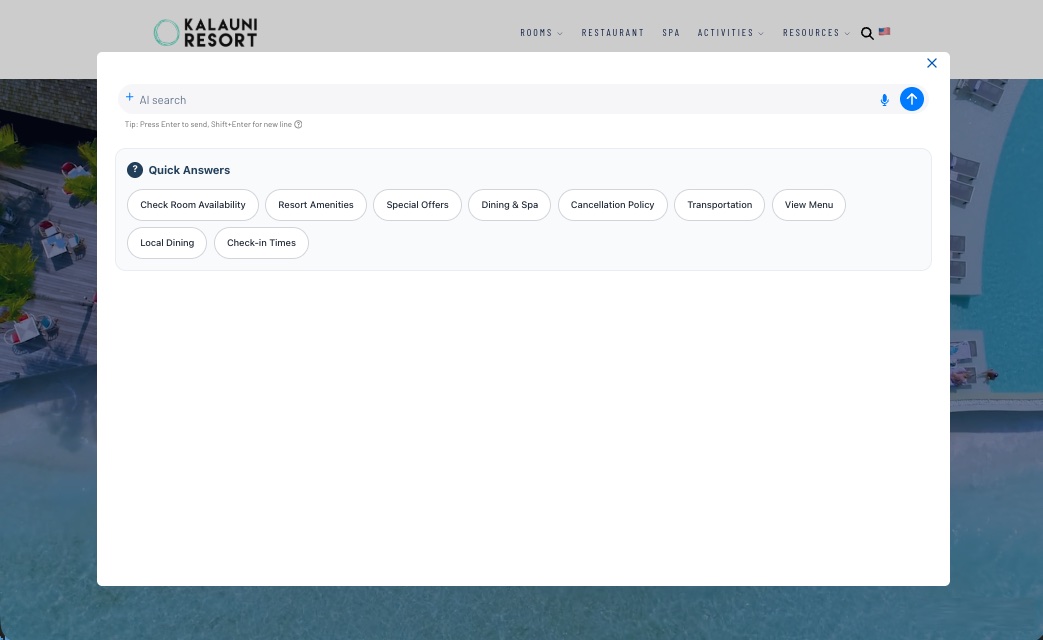
The ai12z CTA (Call-to-Action) Search is a powerful modal dialog component that provides AI-powered search capabilities with a rich, customizable interface. It can serve multiple purposes:
- AI Search Dialog: Full conversational AI search with natural language understanding
- Quick Answer Interface: Display commonly asked questions as quick-action buttons
- Welcome Screen: Present navigation shortcuts or featured content
- Multi-panel Experience: Create custom layouts with multiple information panels
Key Features
- Flexible Input Options: Audio input, image upload, and text search
- Customizable Layout: Position input field at top or bottom, control dialog dimensions
- Complete Control: Custom CSS and JavaScript for full design control
- Quick Answers: Pre-configured question buttons for common queries
- Mobile Optimized: Responsive design that adapts to any screen size
Why Use a Modal Dialog Search?
The modal dialog approach offers significant advantages over embedded search interfaces:
1. Clean Page Design with On-Demand Access
Add a simple magnifying glass icon or search button anywhere on your page. When clicked, the full-featured AI search interface appears as a modal dialog, keeping your page layout clean and uncluttered while providing powerful search capabilities when needed.
Example: A header navigation bar with a search icon that opens the complete AI search experience.
2. Wizard-Based Query Generation
Create interactive wizards or forms that collect user inputs, then programmatically construct an AI query from those selections. The modal dialog displays the AI-generated answer based on the wizard's output.
Example: A product finder wizard where users select preferences (price range, features, use case), and when they click "Find Products," the CTA dialog opens with an AI-generated recommendation based on their selections.
// Collect wizard inputs
const preferences = {
  priceRange: "$500-$1000",
  skill: "intermediate",
  terrain: "all-mountain",
}

// Generate query and open dialog with AI answer
const query = `Recommend ski boots for ${preferences.skill} skier, ${preferences.terrain} terrain, budget ${preferences.priceRange}`
ctaDialog.setAttribute("question", query)
ctaDialog.action() // Opens dialog with AI answer
3. Context-Specific Help Dialogs
Trigger the search dialog from anywhere on your page with pre-populated questions or context. Different buttons or links can open the same dialog with different initial queries.
Example: Multiple "Learn More" links throughout a product page, each opening the dialog with a specific question relevant to that section.
4. Space-Efficient Mobile Experience
On mobile devices, the modal takes over the full screen, providing an optimal user experience without compromising functionality or requiring dedicated page real estate.
5. Focused User Attention
The modal overlay focuses user attention on the search interaction, reducing distractions and improving engagement with AI-generated answers.
Common Use Cases:
- Global site search: Magnifying glass icon in navigation
- Product recommendations: Wizard-based product finders
- Customer support: Context-sensitive help buttons
- Documentation search: Quick access to knowledge base
- Lead generation: Interactive quizzes that provide AI-powered recommendations
The CTA Search provides an elegant way to offer AI-powered assistance without cluttering your page. Users can access comprehensive search functionality on-demand through a modal dialog, maintaining clean page layouts while providing powerful search capabilities.
Managing Configurations
Creating a New Configuration
To create a new CTA Search configuration:
- Navigate to your Agent dashboard
- Select Web Controls from the left navigation panel
- Click on
<ai12z-cta>Search - Click the Add Web Config button in the top right
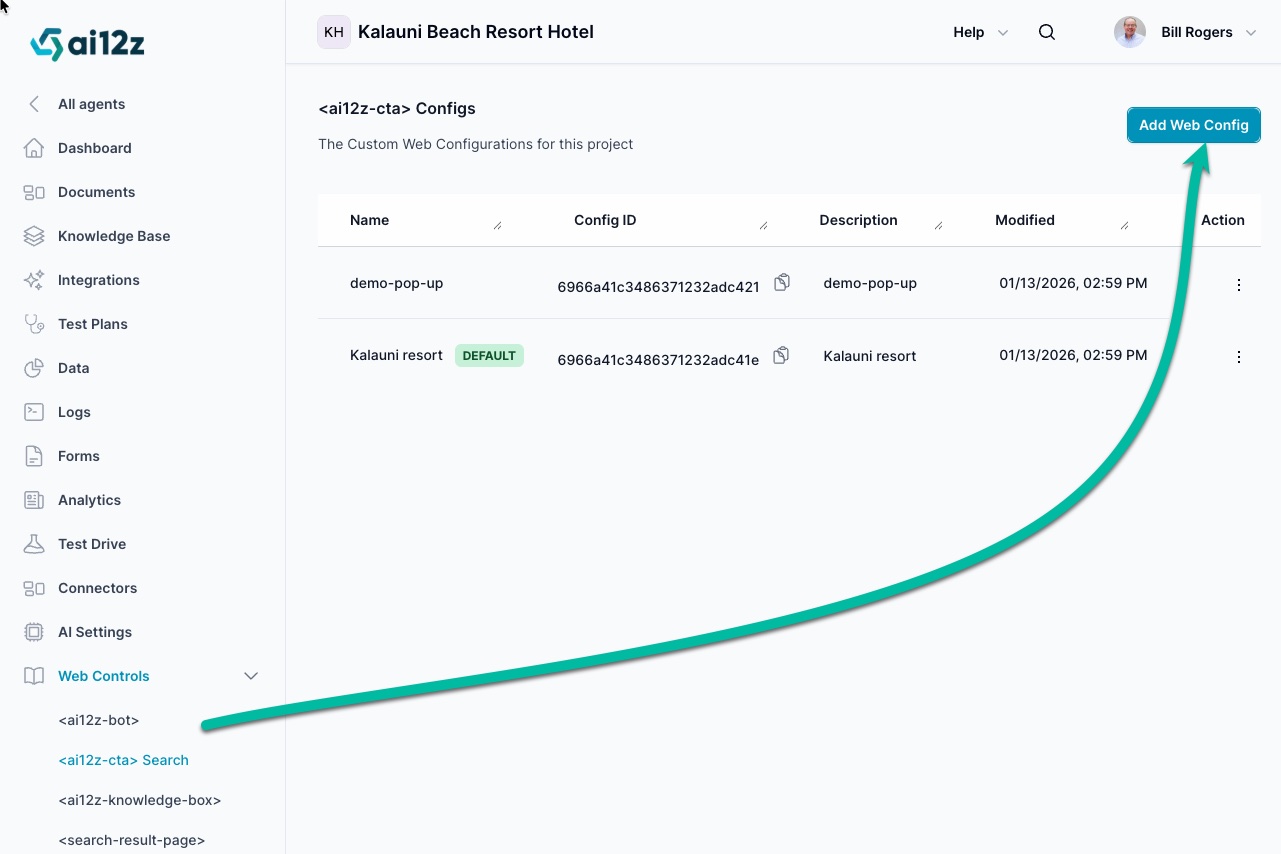
List of Configurations
The configuration list displays all your CTA Search configurations. Each entry shows:
| Field | Description |
|---|---|
| Name | A descriptive identifier for the configuration |
| Config ID | Unique identifier used to reference this configuration in your code with the config-id attribute |
| Description | Brief explanation of the configuration's purpose |
| Modified | Last update date and time |
| Default | Badge indicating which configuration is the default |
| Action | Menu with options to edit, preview, or delete the configuration |
Using a Configuration
When you have multiple configurations, specify which one to use by adding the config-id attribute:
<!-- Using a specific configuration -->
<ai12z-cta data-key="<API_KEY>" config-id="6966a41c3486371232adc421">
</ai12z-cta>

<!-- Using the default configuration -->
<ai12z-cta data-key="<API_KEY>"></ai12z-cta>
Configuration Tabs
Each configuration consists of five main tabs: Display, Settings, Welcome, Style, and Script. These tabs allow you to control different aspects of the CTA Search behavior and appearance.
Display Tab
The Display tab controls the visual appearance and layout of your CTA Search dialog.
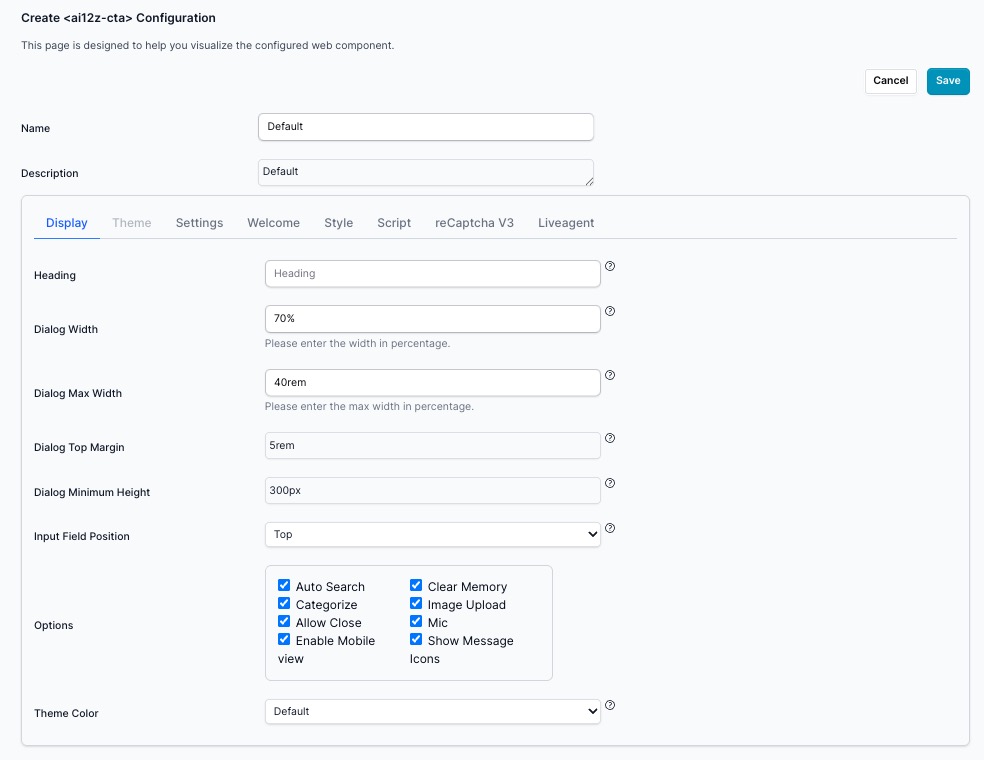
Basic Information
| Setting | Description | Example |
|---|---|---|
| Name | Configuration identifier (used only in admin list view) | "Default", "Mobile Search", "Help Dialog" |
| Description | Brief explanation of configuration purpose (admin only) | "Main search for homepage", "Kalauni resort" |
Dialog Layout
| Setting | Description | Default/Example |
|---|---|---|
| Heading | Text displayed at the top of the dialog | Leave blank or "How can we help you today?" |
| Dialog Width | Width of the dialog box | "70%" |
| Dialog Max Width | Maximum width constraint | "40rem" |
| Dialog Top Margin | Space from top of viewport to dialog | "5rem" |
| Dialog Minimum Height | Minimum height of the dialog | "300px" |
| Input Field Position | Where to place the search input | "Top" or "Bottom" |
Options
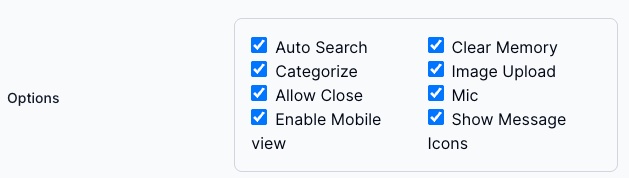
The Options section provides checkboxes to control various features:
| Option | Description |
|---|---|
| Auto Search | When enabled, automatically executes search when text is sent via JavaScript. When disabled, only populates the search box |
| Categorize | When enabled, shows search results grouped by category as you type |
| Allow Close | When enabled, displays a close icon (X) in the dialog |
| Enable Mobile view | When enabled (default), dialog takes over entire screen on small devices for optimal mobile experience |
| Clear Memory | When enabled, provides option in the + menu to clear conversation history |
| Image Upload | When enabled, allows users to upload images via the + menu for visual analysis with their query |
| Mic | When enabled, provides voice input capability for hands-free search |
| Show Message Icons | When enabled, displays icons alongside messages (uses default icons if custom ones aren't uploaded) |
Theme Color
The Theme Color dropdown allows you to choose a visual theme for your CTA Search dialog. The theme controls colors, styling, and overall appearance.
Available Options:
- Preset Themes: Pre-configured color schemes including Default, Cyan, Amber, Orange, Purple, Red, Pink, Brown, Slate, Sky, Lime, Yellow, and Indigo
- Custom: Create a personalized theme using your brand colors and CSS variables
Custom Theme Creation
Selecting Custom enables the Theme tab in the CTA configuration. The Theme tab displays a CSS variables editor on the left, pre-populated with your CTA's current theme values, and a Vibe Coding panel on the right.
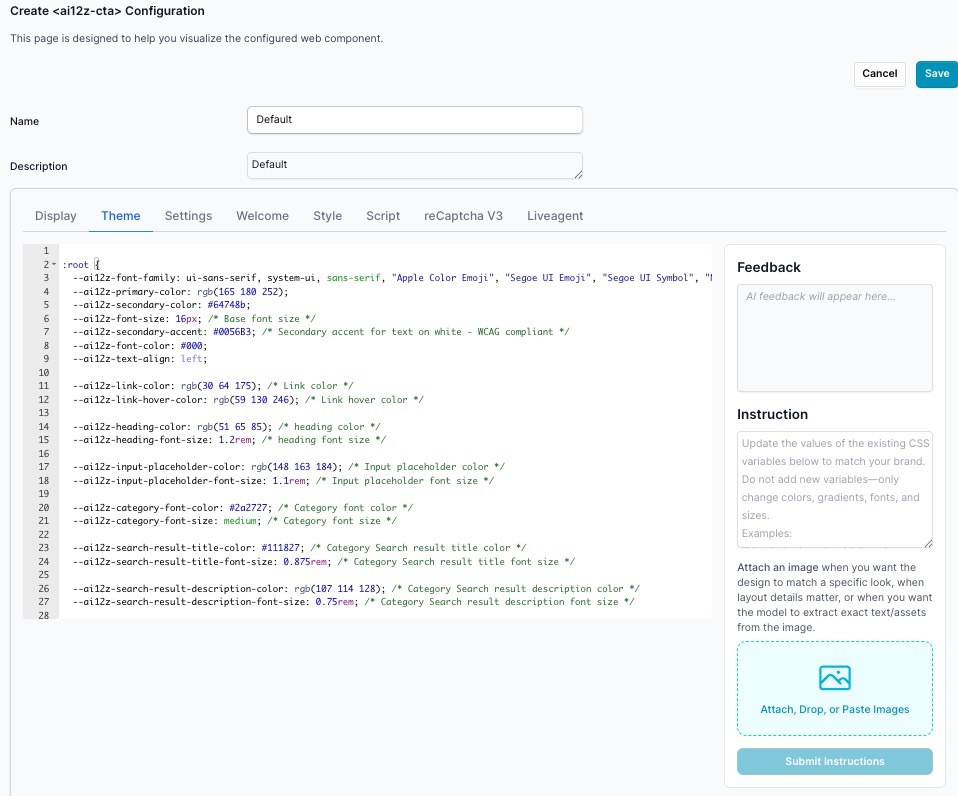
Tip: Before creating a custom theme, complete the AI Brand Creation process first. Your saved brand guidelines are automatically referenced when generating a custom theme, so the output will already reflect your brand's colors, fonts, and style.
To create a custom theme:
-
Set up Brand Guidelines (Recommended)
- Navigate to AI Settings → Brand Guidelines
- Follow the AI Brand Creation guide to paste your Figma Design Tokens JSON, plain text brand guidelines, or upload screenshots of your website
- Save your brand guidelines
-
Select Custom Theme
- Return to your CTA configuration
- Choose Custom from the Theme Color dropdown
-
Customize with Vibe Coding or Manual Editing
- The Theme tab opens with a CSS variables editor pre-loaded with the default custom theme
- To use Vibe Coding: Type your instructions in the Instruction box on the right panel — for example, "Update the primary color to match our teal brand" or "Apply our brand guidelines to this theme." You can also paste Figma Design Tokens JSON directly into the instruction box, or attach screenshots for the AI to match. Click Submit Instructions and the AI updates the CSS variables for you
- To edit manually: Modify the CSS variable values directly in the editor on the left
- Review AI feedback in the Feedback panel, then click Save
Benefits of Custom Theme with Brand Guidelines:
- Brand Consistency — Automatically matches your website's visual identity
- Professional Appearance — Cohesive design that reflects your brand personality
- Time Saving — No manual color picking or style configuration needed
- Responsive Design — Optimized for all device sizes while maintaining brand integrity
Settings Tab
The Settings tab controls behavior, limits, voice settings, and search parameters.
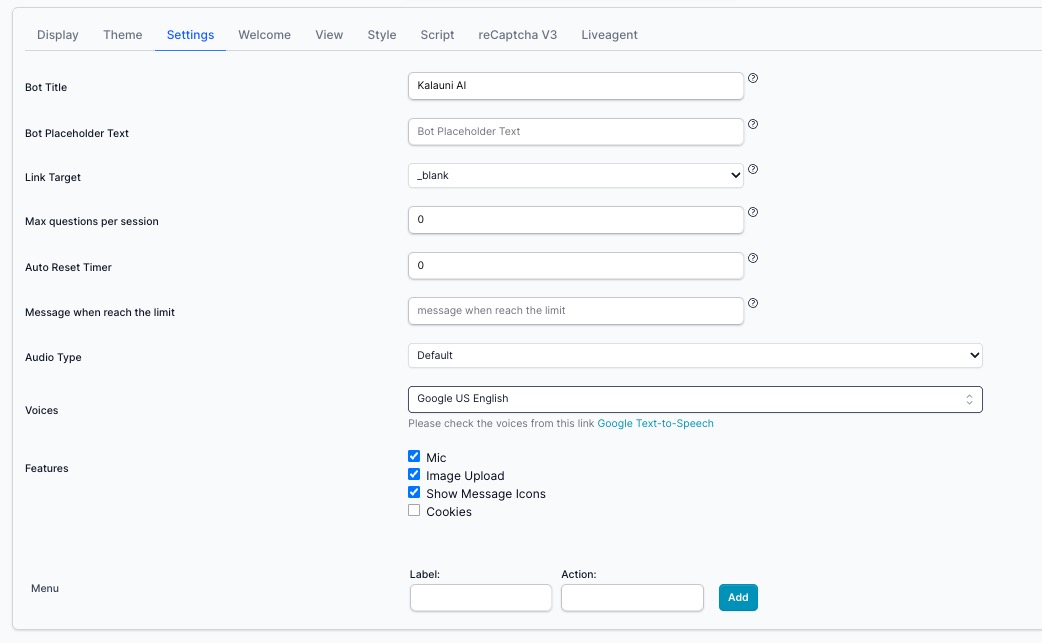
Configuration Settings
| Setting | Description | Default/Example |
|---|---|---|
| No Results Text | Message shown when no search results are found | "No results found" |
| Placeholder | Placeholder text in the search input field | "AI search" |
| Link Target | How search result links open | _blank (new tab) |
| Max questions per session | Maximum number of questions allowed per session (prevents abuse) | 5 |
| Auto Reset Timer | Minutes of inactivity before resetting the session | 0 (disabled) |
| Message when reach the limit | Text shown when question limit is reached | "Sorry, you have reached your message limit" |
| Audio Type | Audio feedback style | "Default" |
| Voices | Text-to-speech voice selection | "Google US English" |
| Max Results | Maximum number of search results to display | 4 |
| Score | Minimum relevance score threshold (0-1 slider) | 0.6 |
Preventing Chatbot Abuse and Token Drain
Overview
If a public-facing CTA Search is targeted by automated spam (bots/scripts), it can generate excessive AI requests and consume tokens. ai12z provides controls to mitigate this:
- Max Questions per Session - Hard usage cap per session
- Auto Reset Timer - Automatically reset sessions after inactivity
- reCAPTCHA v3 - Bot detection (can be configured separately)
Max Questions per Session
What it does:
Max Questions per Session sets a hard ceiling on how many questions a single chat session can send to the AI. Once the limit is reached, the bot stops issuing additional AI requests, preventing further token spend from that session.
Why it prevents token drain
Even if a bot attempts to spam the chat UI, it cannot generate unlimited AI calls within the same session—usage is capped.
Note: See Directives [directive=badActor] for one of the best ways to eliminate a bad actor.
Where to configure
In your <ai12z-cta> configuration:
- Go to Settings
- Set Max questions per session
- (Optional) Set Message when reach the limit (recommended for clear UX)
- (Optional) Configure Auto Reset Timer to reset the session after a defined period of inactivity (or leave at
0if you want the cap to effectively require a new session)
Recommended settings (baseline)
- Max questions per session:
10–25(start at 20 for most sites) - Message when reach the limit: “You’ve reached the question limit for this session. Please try again later.”
- Auto Reset Timer:
30–60 minutes(or0if you prefer stricter behavior)
Welcome Tab
The Welcome tab allows you to create custom welcome screens with Quick Answer buttons, FAQs, or multi-panel layouts.
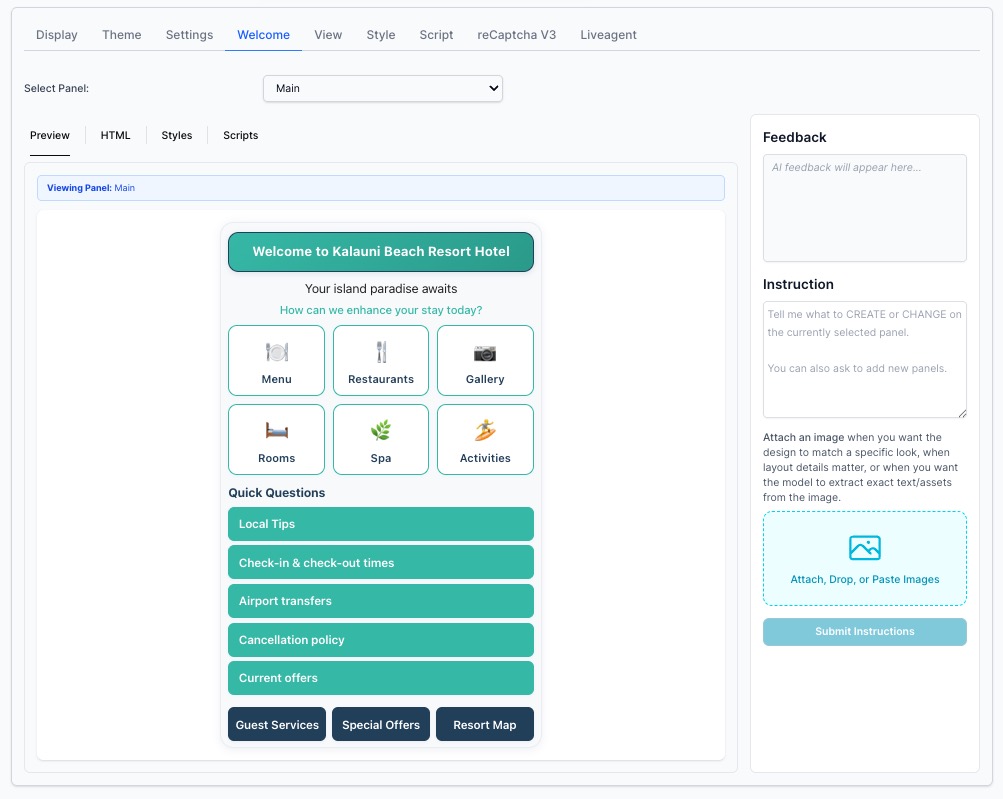
Features
- Custom HTML: Insert any HTML content in the welcome screen
- Quick Answer Buttons: Create pre-configured question buttons that users can click
- Multi-panel Support: Build complex layouts with multiple information panels
- Interactive Elements: Use
sendMessage()andsendJSON()for dynamic interactions - Dedicated Styling: Welcome panel has its own Styles and Scripts tabs for customization
Select Panel
Choose which panel to edit from the dropdown (e.g., "Main" panel).
Preview Tabs
- Preview: See how your welcome screen looks
- HTML: Edit the HTML content
- Styles: Add custom CSS for the welcome panel - this Styles is just for the welcome screen
- Scripts: Add custom JavaScript for welcome panel interactions - this Scripts is just for the welcome screen,
The sytles and Scripts in the top menu is the global scripts and styles, often has nothing it it. The vibe coding for welcome screen only effects the Styles and Scripts for the welcome screen. If it is not meant for the welcome screen put it in the global.
Feedback Panel
Displays real-time feedback as you make changes to help you understand the results of your customizations.
Instruction Panel
Use AI to generate or modify your welcome panels:
- Describe what you want to create or change
- Optionally attach an image for design reference
- Click Submit Instructions
- The AI will generate the panel layout based on your description
Example: Kalauni Resort Welcome Screen
The screenshot shows a hospitality-focused welcome screen with:
- Heading: "How can we help you today?"
- Quick Answer Buttons: Common questions organized in three rows:
- Row 1: Room availability, Resort amenities, Spa services
- Row 2: Restaurant & dining, Activities, Special offers
- Row 3: Cancellation policy, Transportation, Check-in times
- Action: Each button triggers an instant AI response
This provides guests with immediate access to frequently requested information.
Style Tab, Global styles
The Style tab allows you to add custom CSS to further customize the appearance of your CTA Search beyond the theme settings. Don't put Styles for the Wecome screen
Note: The Welcome tab has its own dedicated Styles sub-tab for welcome panel-specific styling.
Custom CSS
Use the Custom CSS editor to:
- Override default styles
- Add responsive design rules
- Customize specific elements within the dialog
- Match your site's design system
Script Tab, Global styles
The Script tab enables you to add custom JavaScript to enhance or modify the CTA Search behavior. Don't put welcome screen script in this tab.
Note: The Welcome tab has its own dedicated Scripts sub-tab for welcome panel-specific functionality.
Custom JavaScript
Use the Custom JS editor to:
- Add event listeners for user interactions
- Integrate with analytics or tracking tools
- Implement custom business logic
- Extend functionality beyond default capabilities
View Tab
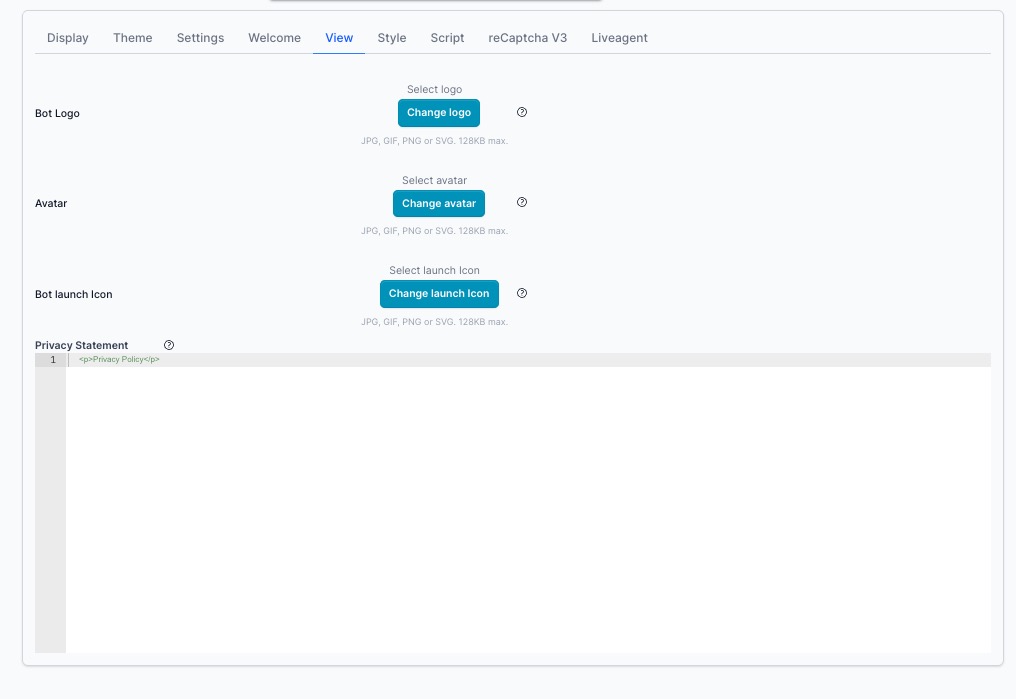
The View tab manages the visual identity assets for your CTA Search — the images and branding elements that appear within the interface — as well as the privacy statement shown to users.
Bot Logo
Upload a logo image that appears inside the CTA dialog. This is typically your primary brand mark or wordmark.
- Button: Click Change logo to upload or replace the current logo
- Accepted formats: JPG, GIF, PNG, or SVG
- Max file size: 128KB
Avatar
The avatar is the icon or image that represents the AI assistant within the conversation. It appears alongside AI responses to give the assistant a visual identity.
- Button: Click Change avatar to upload or replace the current avatar
- Accepted formats: JPG, GIF, PNG, or SVG
- Max file size: 128KB
Bot Launch Icon
The launch icon is the image displayed on the button or trigger that users click to open the CTA dialog. Customize this to integrate seamlessly with your site's design.
- Button: Click Change launch Icon to upload or replace the current icon
- Accepted formats: JPG, GIF, PNG, or SVG
- Max file size: 128KB
Privacy Statement
The Privacy Statement is an HTML field that displays a brief privacy notice to users within the CTA interface. Use this to communicate your data practices or link to your full privacy policy.
Example:
<p>Privacy Policy</p>
Best Practices:
- Keep the message short and clear
- Link to your complete privacy policy page using an anchor tag
- Use reassuring language about data protection
Example with link:
<p>
  Your privacy is important to us.
  <a href="/privacy-policy" target="_blank">View our Privacy Policy</a>
</p>
reCAPTCHA V3 Tab
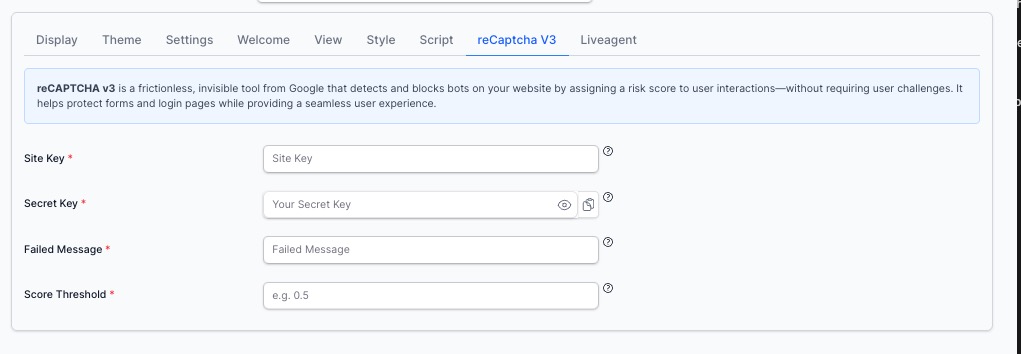
reCAPTCHA v3 is a frictionless, invisible tool from Google that detects and blocks bots on your website by assigning a risk score to user interactions — without requiring user challenges like checkboxes or image puzzles. It helps protect your CTA Search from automated abuse while providing a seamless experience for real users.
When enabled, every interaction with the CTA Search is scored by Google. Interactions falling below your configured threshold are blocked before any AI request is made, protecting against token drain and spam.
Fields
| Field | Required | Description |
|---|---|---|
| Site Key | Yes | The public key from your Google reCAPTCHA v3 registration. Used in the front-end to load the reCAPTCHA script |
| Secret Key | Yes | The private key from your Google reCAPTCHA v3 registration. Used server-side to verify the token score |
| Failed Message | Yes | The message displayed to the user when their interaction is blocked due to a low reCAPTCHA score |
| Score Threshold | Yes | A value between 0.0 and 1.0. Interactions scoring below this threshold are blocked. Google recommends starting at 0.5 |
Getting Your reCAPTCHA v3 Keys
- Go to Google reCAPTCHA Admin Console
- Click + to create a new site
- Select reCAPTCHA v3 as the type
- Add your domain(s)
- Copy the Site Key and Secret Key into the fields above
Score Threshold Guide
| Score | Meaning |
|---|---|
1.0 | Very likely a human |
0.5 | Recommended starting threshold |
0.3 | More permissive — allows more borderline traffic |
0.0 | No filtering (effectively disabled) |
Start at 0.5 and adjust based on your traffic patterns. If legitimate users are being blocked, lower the threshold slightly. If you're still seeing abuse, raise it.
Failed Message Example
Our system detected unusual activity. Please try again or contact support if this continues.
Keep the message user-friendly — legitimate users can occasionally receive a low score on restricted networks or with VPNs.
Best Practice: Combine with Max Questions per Session
reCAPTCHA v3 blocks automated traffic before AI requests are made. Pairing it with Max Questions per Session (in the Settings tab) provides two layers of protection:
- reCAPTCHA v3 — blocks bots at the entry point
- Max Questions per Session — caps usage for any session that gets through
Together they significantly reduce the risk of token drain from automated abuse.
Liveagent Tab
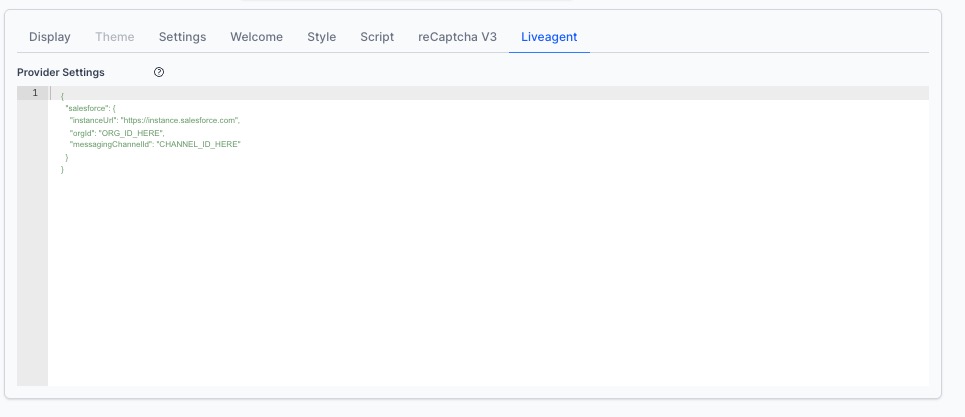
The Liveagent tab allows you to connect your CTA Search to a live agent platform, enabling seamless handoff from the AI assistant to a human agent when needed. When configured, the CTA can escalate conversations to a live support channel based on user intent or explicit request.
Provider Settings
The Provider Settings field accepts a JSON configuration object that defines your live agent provider and connection details. The structure varies by provider.
Salesforce Example
{
  "salesforce": {
    "instanceUrl": "https://instance.salesforce.com",
    "orgId": "ORG_ID_HERE",
    "messagingChannelId": "CHANNEL_ID_HERE"
  }
}
| Field | Description |
|---|---|
instanceUrl | The URL of your Salesforce instance (e.g., https://yourorg.my.salesforce.com) |
orgId | Your Salesforce Organization ID, found in Setup → Company Information |
messagingChannelId | The Messaging Channel ID for the Salesforce Messaging for In-App and Web channel configured for live agent handoff |
Getting Your Salesforce Values
- Instance URL — Log in to Salesforce and copy the base URL from your browser (e.g.,
https://yourorg.my.salesforce.com) - Org ID — Go to Setup → Company Information and copy the Salesforce Organization ID
- Messaging Channel ID — Go to Setup → Messaging Settings, open your Messaging for In-App and Web channel, and copy the Channel ID from the URL or channel detail page
How It Works
Once configured, the CTA Search can route users to a live agent when:
- The user explicitly requests a human agent
- The AI detects a conversation topic that should be handled by a human
- A configured directive or rule triggers an escalation
The live agent chat session opens within the same CTA dialog, providing a continuous experience without redirecting the user to a separate support page.
Best Practices
Configuration Management
- Use Descriptive Names: Name configurations based on their use case (e.g., "Homepage Search", "Support Dialog", "Mobile CTA")
- Set a Default: Always designate one configuration as default for fallback behavior
- Test Responsive Design: Verify dialog appearance on desktop, tablet, and mobile devices
Welcome Screen Design
- Limit Quick Answers: Use 6-12 buttons maximum to avoid overwhelming users
- Organize by Topic: Group related questions together
- Use Clear Labels: Make button text concise and action-oriented
- Consider Context: Tailor quick answers to the page or section where the CTA appears
Performance Optimization
- Set Question Limits: Protect against abuse with reasonable session limits
- Enable Auto Reset: Use Auto Reset Timer for better user experience
- Optimize Welcome HTML: Keep welcome screen HTML lightweight
- Test Load Times: Ensure dialog opens quickly on slower connections
Voice and Audio
- Choose Appropriate Voice: Select a voice that matches your brand personality
- Test Audio Type: Verify audio feedback works across different browsers
- Consider Accessibility: Voice features help users with visual impairments
Related Documentation
- CTA Search Component - Main component documentation
- Agent Settings - Managing your agent and API keys
- AI Brand Creation - Customizing theme with brand guidelines