URL Analysis
Get a complete AI citation and discoverability audit for any single page on your site.
URL Analysis scrapes one page, reads it the way an AI crawler or answer engine would, and scores it across 19 independently-graded sections: structure, metadata, schema, trust signals, tone, entity specificity, page speed, and several sections most audits don't even attempt: whether your headings are phrased as questions with answer-first paragraphs, whether the page carries the "fitness signals" AI uses to decide who to recommend, whether the same answer already exists anywhere else on the web, and whether AI can even describe your brand from what's on the page. Every finding comes with the exact rewrite, schema snippet, or missing element, not just a score.
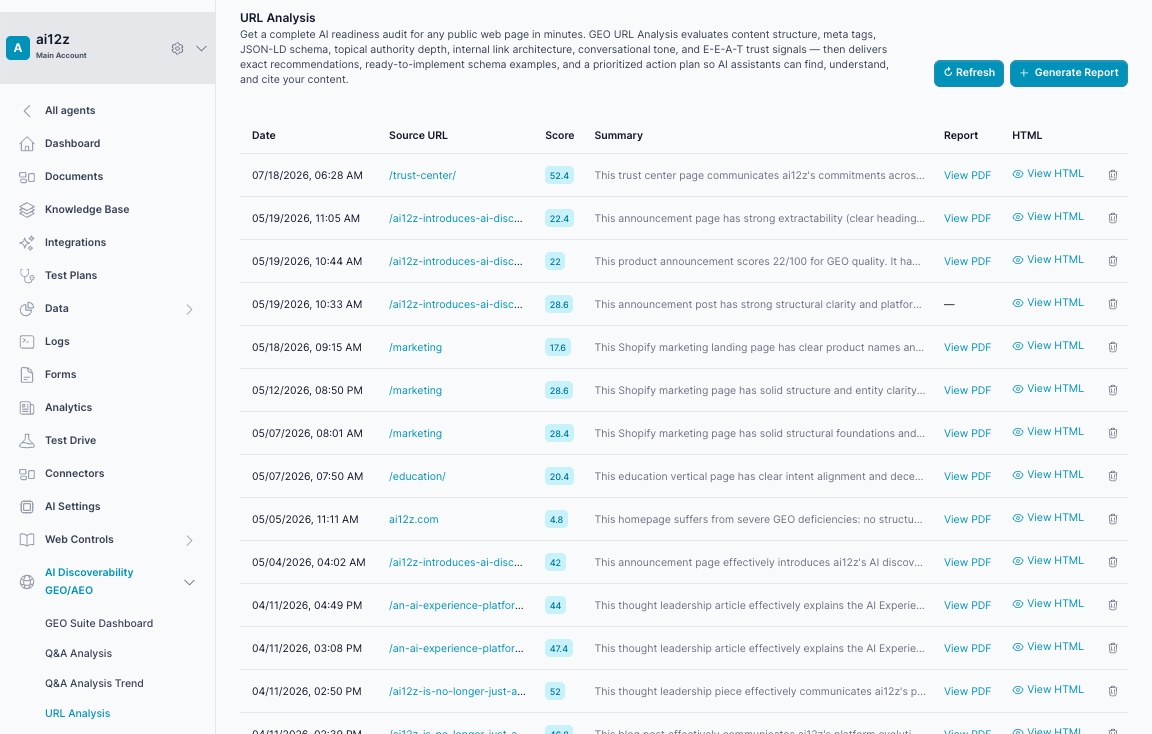
What It Does
- Scrapes and analyzes any page under your own registered domain
- Scores the page on the GEO Score (0–100): a Body Score (0–70) plus an Eligibility Score (0–30), minus any penalties
- Audits meta tags (title, description) with specific rewrite recommendations
- Analyzes JSON-LD structured data with exact fix examples and ready-to-paste schema, using your actual page content
- Assesses FAQ coverage and suggests a ranked list of missing Q&A pairs, each with priority and draft answer copy
- Evaluates calls-to-action for clarity, prominence, and completeness (including CTAs a page in your category should have but doesn't)
- Scores Answer-First Structure: whether your H2s are phrased as the questions buyers ask, and whether each one opens with a direct 40–60 word answer
- Scores Fitness Signals: the "is this the right product for me" markers (use cases, pricing, reviews, case studies, comparisons) AI checks before recommending you
- Scores Cross-Platform Amplification: whether the same key answers exist anywhere besides your website (YouTube, community forums, help docs), since AI weights consensus across sources
- Scores Brand Story Completeness: whether AI can answer "tell me about [company]" from what's on the page (founding year, founders, mission, awards)
- Analyzes topical authority depth (are you covering the full topic or just a surface slice?), with recommended supporting pages to build a hub-and-spoke cluster
- Audits internal link architecture: is this page building a navigable topic cluster AI can follow, or is it isolated?
- Checks conversational tone: flags jargon and passive voice sentence-by-sentence, with a plain-language rewrite for each
- Evaluates E-E-A-T trust signals: certifications, named authorship, years-in-business, and association citations, each with a recommended placement
- Scores entity density & node specificity: measures named entities vs. generic marketing phrases, flags vague sentences verbatim, and gives an exact substitution for each one
- Measures page ingestion time and audits every image on the page (size, format, dimensions, lazy-load, alt text)
- Produces a prioritized, PDF-ready improvement plan ranked by impact
How to Generate a Report
🛠️ Step 1: Navigate to URL Analysis
From the ai12z GEO portal, select URL Analysis from the navigation menu.
🛠️ Step 2: Click + Generate Report
Click the + Generate Report button in the top-right corner.
🛠️ Step 3: Enter the URL
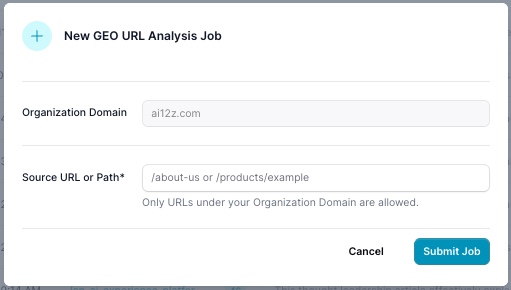
| Field | Description |
|---|---|
| Organization Domain | Your account's registered root domain (e.g., ai12z.com) |
| Source URL or Path* | Required. A path (/about-us) or full URL; must be under your Organization Domain |
URL Analysis only audits pages under your own registered domain: you can't point it at a competitor's site. If you need competitive insight instead of a page audit, use Citation Monitor or AI Footprint.
🛠️ Step 4: Submit and Wait
Click Submit Job. The analysis runs asynchronously. Click Refresh to check for completion.
🛠️ Step 5: View Your Report
Once complete, click View PDF for the full report, or View HTML to open the Page Preview modal.
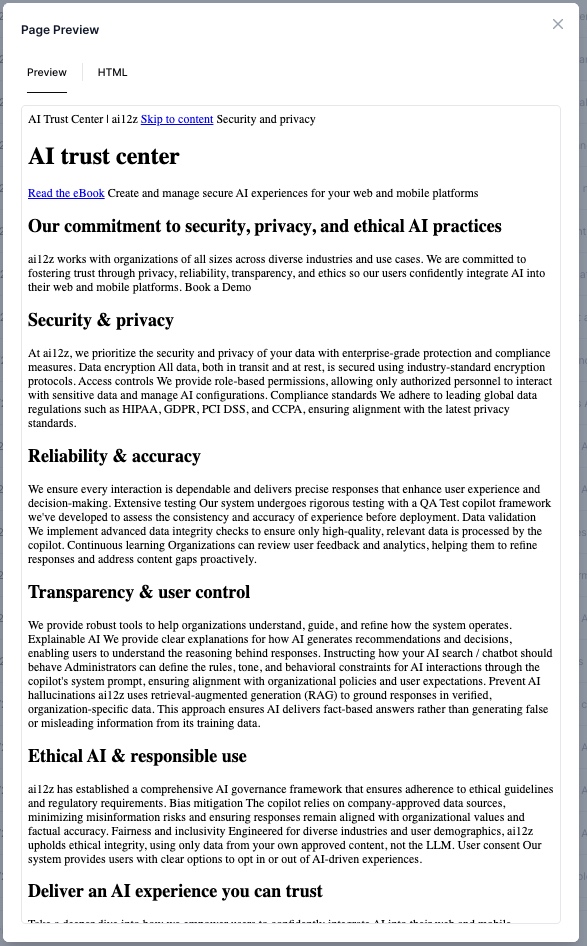
The Preview tab shows the clean, sanitized text ai12z actually extracted and scored: the same normalized content an AI crawler or RAG pipeline would ingest, stripped of navigation chrome and scripts. If a score looks wrong, check this first: it's the fastest way to confirm the analysis read the same content a human sees on the live page, and it's the same extraction path used to feed page content into your knowledge base for ingestion.
What's Inside the PDF
The report keeps the original section numbering from the underlying job (some numbers, like Section 09, are conditional and may not appear on every page), so you can jump straight to a section by name when reviewing the PDF.
| Section | Covers |
|---|---|
| 01 · Executive Summary | Top strengths, key weaknesses, and top actions for this specific page |
| 02 · Score Breakdown | All 13 lettered dimensions (A–M), each scored out of 10, plus the Eligibility Score formula and any penalties applied |
| 03 · FAQ & Extractable Answer Opportunities | Whether an FAQ section exists, plus a ranked list of suggested Q&A pairs with draft answers and priority |
| 04 · Content Structure Review | H1 clarity, answer placement, use of lists/tables, and heading hierarchy issues |
| 04A · Meta Tags Analysis | Title and description: length, quality, issues, and a recommended rewrite for each |
| 04B · Call-to-Action Analysis | Every CTA found (text, action, location, prominence), issues, and specific fixes |
| 05 · Authority & Trust Gaps | Missing trust elements (certifications, named contacts, audit dates, SLAs) with recommended additions and impact |
| 06 · Structured Data & JSON-LD Analysis | Schemas detected, missing properties, and ready-to-paste JSON-LD using your actual content |
| 07 · Content Gaps Blocking Strong GEO Performance | Missing topics/signals competitors cover, typed and ranked by impact |
| 08 · Citeability Improvement Plan | The specific edits, ranked by impact, that raise citation probability fastest |
| 10 · Answer-First Structure Score | How many headings are phrased as questions with an answer-first paragraph, with before/after rewrite examples |
| 11 · Fitness Signals | Whether use cases, pricing, reviews, case studies, and comparisons are present, the signals AI uses to judge product fit |
| 12 · Cross-Platform Amplification | Whether this page's key answers also exist on YouTube, community forums, or help docs |
| 13 · Brand Story Completeness | Whether AI could answer "tell me about [company]" from this page alone |
| 14 · Topical Authority Depth | Sub-topics covered vs. missing, plus recommended supporting pages with titles, slugs, and priority |
| 15 · Internal Link Architecture | Internal links found, whether a topic cluster exists, and specific missing link opportunities |
| 16 · Tone Analysis | Jargon density, passive voice, and sentence-level rewrites from corporate phrasing to plain language |
| 17 · E-E-A-T Trust Signals | Experience/Expertise/Authoritativeness/Trustworthiness signals found vs. missing, each with a recommended placement |
| 18 · Entity Density & Node Specificity | Named entities found, vague sentences flagged verbatim, and an exact specific replacement for each |
| 19 · Page Speed & Image Audit | Actual ingestion time, image count, oversized images, and a per-image format/dimension/lazy-load/alt-text table |
Scoring Methodology
The GEO Score (0–100) shown on the cover page is Body Score + Eligibility Score − Penalties. It does not include Sections 10–19; those are independent 0–100 diagnostic scores reported alongside the main score, not folded into it, so a page can carry a middling GEO Score while still scoring very low on, say, Cross-Platform Amplification.
Body Score (0–70) is built from 8 of the 13 lettered dimensions in Section 02:
| Dimension | Measures |
|---|---|
| A · Direct Answer Match | Does the page answer the core question in the first ~200 words? |
| B · Entity Clarity | Are specific named entities used consistently? |
| C · Structure Extractability | Clear headings, lists, tables, FAQ format? |
| D · Topical Completeness | Full topic coverage vs. surface-level treatment |
| E · Evidence Support | Quantified claims, dates, certifications, benchmarks |
| F · Expertise Depth | Specificity of how, not just that |
| G · Freshness | Visible publish/update dates |
| H · Ambiguity Control | Consistent terminology, no contradictions |
Eligibility Score (0–30) is a weighted formula using 3 more of the 13 dimensions:
Eligibility = (J × 8 + K × 5 + M × 2) ÷ 5
| Dimension | Measures |
|---|---|
| J · Structured Data | JSON-LD schema present and well-formed |
| K · Authorship & Date | Visible byline and publish/update date (not just in JSON-LD) |
| M · Update Signaling | Changelog, "last reviewed" banner, or other visible freshness signal |
Two remaining dimensions, I · Crawlability and L · Page Experience, are shown in Section 02 but are not counted in either formula. Both require live-browser telemetry (JS rendering, real page-load metrics) that a static content scrape can't fully verify, so they're reported as 0/10 (cannot assess from content alone) rather than guessed at.
Penalties subtract from the total:
| Penalty | Points |
|---|---|
| Main answer not in first 40% of body | −8 |
| Primary entity ambiguous | −5 |
| Major claim without evidence | −5 |
| Generic headings | −3 |
| Section contradictions | −3 |
Key Outputs
- GEO Score (0–100): Body Score + Eligibility Score − Penalties, with the full dimension-by-dimension breakdown
- Executive Summary: Top strengths, key weaknesses, and top actions specific to this page
- 19 Scored Sections: Full findings for every area listed in What's Inside the PDF
- Answer-First Structure Score: Question-format heading coverage with rewritten heading + answer-paragraph examples
- Fitness Signals Score: A pass/fail checklist of the buyer-fit signals AI looks for before recommending you
- Cross-Platform Amplification Score: Which of your key answers exist only on your website vs. also on YouTube, community, or help docs
- Brand Story Completeness Score: Whether AI can describe your company from this page alone
- Meta Tag Recommendations: Exact suggested rewrites for title and description
- JSON-LD Examples: Ready-to-implement schema blocks with your content already filled in
- CTA Improvements: Specific wording, placement, and missing-CTA recommendations
- Entity Density Report: Specificity label, named entities detected, vague sentences flagged verbatim, and an exact substitution for each
- Tone Rewrites: Flagged sentences with a plain-language rewrite and the specific issue (buzzword, passive voice, lacks specifics)
- Page Speed & Image Report: Ingestion time rating, total image weight, and a per-image compression/format/attribute table
- PDF Report: Complete 19-section audit document
- HTML/Page Preview: The sanitized text extraction used for scoring, for side-by-side verification
Understanding the Report Table
| Column | Description |
|---|---|
| Date | When the report was generated |
| Source URL | The page that was analyzed |
| Score | GEO Score (0–100) |
| Summary | Brief description of findings |
| Report | Link to download the PDF |
| HTML | Link to open the Page Preview modal |
Perfect For
- SEO specialists optimizing individual pages
- Content creators improving existing articles
- Developers implementing structured data
- Marketing teams strengthening landing pages
- Trust, security, and compliance teams turning a marketing-toned trust or security page into a verifiable, citable trust artifact
- Local service businesses building topical authority
- Anyone preparing content for AI citation
Example Report Walkthrough
A real audit of https://ai12z.com/trust-center/ produced a GEO Score of 52.4: Body Score 45.4, Eligibility Score 12.0/30, with 1 penalty applied:
Body Score:        45.4
Eligibility Score: +12.0   (J=6, K=2, M=1 → (6×8 + 2×5 + 1×2) ÷ 5 = 12.0)
Penalty:            −5.0   (major claim without evidence)
                   ------
GEO Score:          52.4
Executive Summary captured it in one line: the page "communicates ai12z's commitments... but reads as marketing rather than a verifiable trust artifact." Top strengths were a clear four-pillar H2 structure and named compliance frameworks (HIPAA, GDPR, PCI DSS, CCPA). Key weaknesses: zero quantified evidence (no SOC 2/ISO certifications, no audit dates, no uptime SLA) and no visible dates, author, or update signals.
Score Breakdown showed exactly where the points were lost: Evidence Support scored 3/10 ("zero quantified claims"), Freshness scored 2/10 (a dateModified existed in JSON-LD but was never shown to users), and both Crawlability and Page Experience came back 0/10 as not-assessable from content alone.
FAQ & Extractable Answer Opportunities found no FAQ section on the page and suggested 7 ready-to-add questions, including "Is ai12z SOC 2 or ISO 27001 certified?" and "Does ai12z use customer data to train LLMs?", each pre-written and priority-ranked.
Structured Data & JSON-LD Analysis listed the schemas already present (WebPage, Organization, WebSite, BreadcrumbList, ImageObject) and handed over paste-ready code for what was missing:
<script type="application/ld+json">
{
  "@context": "https://schema.org",
  "@type": "FAQPage",
  "mainEntity": [{
    "@type": "Question",
    "name": "How does ai12z prevent AI hallucinations?",
    "acceptedAnswer": {
      "@type": "Answer",
      "text": "ai12z uses retrieval-augmented generation (RAG) to ground responses in verified, organization-specific data."
    }
  }]
}
</script>
Tone Analysis (6/100) flagged four buzzword-heavy sentences and rewrote each one, for example:
Original: "All data, both in transit and at rest, is secured using industry-standard encryption protocols." Rewrite: "We encrypt data with TLS 1.3 in transit and AES-256 at rest."
Entity Density & Node Specificity (5/100, labeled Mixed) found real named entities already on the page (HIPAA, GDPR, PCI DSS, CCPA, RAG) but flagged phrases too vague to cite, with a direct swap for each:
| Generic Phrase | Specific Replacement |
|---|---|
| "industry-standard encryption protocols" | TLS 1.3 in transit and AES-256 encryption at rest |
| "comprehensive AI governance framework" | AI governance aligned with NIST AI Risk Management Framework and ISO/IEC 42001 |
Answer-First Structure scored just 3/100: zero of the page's headings were phrased as questions. The report rewrote each one, e.g. Security & privacy → How does ai12z protect customer data?, followed by a 40–60 word direct-answer paragraph naming TLS 1.3, AES-256, and SSO/SAML 2.0.
Fitness Signals (3/100) and Brand Story Completeness (2/100) both came back weak (no pricing, no case study, no comparison section, and no founding year or founder names on the page), while Cross-Platform Amplification (2/100) showed that of four key questions this page answers, none exist anywhere else (no YouTube explainer, no community answer, no help-docs mirror).
Page Speed & Image Audit measured actual ingestion at 1.6 seconds (rated Moderate), found 7 images totaling 50.2KB with zero oversized files, but flagged 2 images missing explicit width/height attributes, a small, concrete fix with a measurable ingestion-speed payoff.
Every one of these findings rolled up into Section 08's Citeability Improvement Plan, a single ranked table telling the team exactly what to fix first: name specific standards and versions, add an FAQPage block, add a visible "last reviewed" date and byline, and link out to proof surfaces (status page, sub-processor list, DPA) from each pillar.
Related Documentation
- Site-Wide Sweep: Run this first to find your weakest pages across the whole site, then deep-dive the worst offenders with URL Analysis
- Web Content Quality: The live, per-page quality score that flags a weak ingested page before you decide to audit it here
- Q&A Analysis: Find out which pages your customers are actually asking about before deciding which URL to audit next
- Agent-Readiness Audit: Check whether AI crawlers can even reach this page before optimizing its content
- AI Visibility Suite Overview: How URL Analysis fits alongside the rest of the AI Visibility Suite